Speech Therapy for Parkinson’s: How SPEAK OUT!® Can Help
Parkinson’s disease is usually described in terms of movement: tremor, stiffness, slowness. Speech and voice are affected in the large majority of people with Parkinson’s too, and that part is frequently addressed late, if at all.
How Parkinson’s affects communication
The same processes that make movement smaller and slower affect the muscles used for speech. Common changes include:
- Reduced volume. The voice becomes quiet, often without the speaker noticing.
- Monotone delivery. Less pitch variation, which flattens emotional expression.
- Hoarse or breathy quality.
- Imprecise articulation, making speech harder to follow.
- Rate changes: sometimes rushing, sometimes hesitating.
- Reduced facial expression, which listeners read as disengagement.
- Swallowing difficulty, which carries medical risk and warrants assessment.
There is a particular cruelty in the volume change: the internal calibration shifts, so speech that sounds normal from the inside is barely audible from across the room. People are told constantly that they are mumbling, which is both inaccurate and demoralizing. The withdrawal that follows is often the real cost: declining phone calls, going quiet in groups, letting a spouse speak for them.
Why standard advice does not hold
“Speak up” fails because it treats this as a volume knob. In Parkinson’s, speech shifts from an automatic process to one that needs deliberate effort, and the internal feedback that tells you how loud you are has drifted. Effective treatment retrains both: producing adequate voice, and recalibrating the perception of it.
What SPEAK OUT!® is
SPEAK OUT!® is a therapy program developed by Parkinson Voice Project specifically for people with Parkinson’s. Its central principle is teaching participants to speak with intent: converting speech from an automatic activity into a deliberate one, which is more resistant to the effects of the disease.
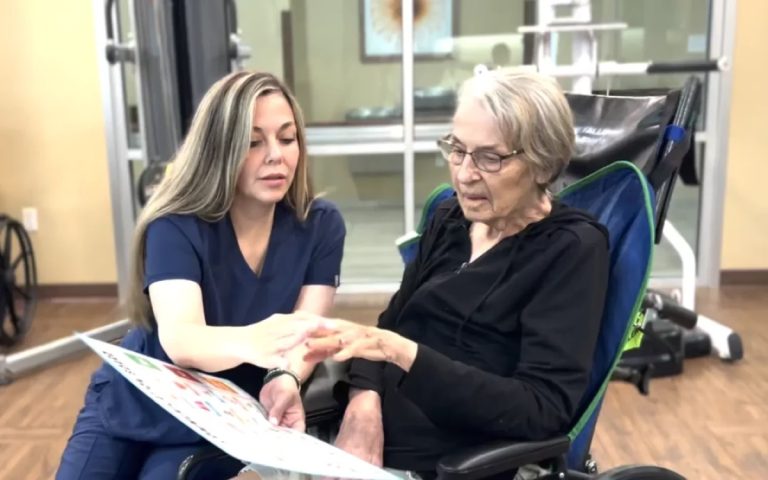
The program typically involves a course of individual sessions with a trained SLP, working through structured speech, voice, and cognitive exercises with a workbook, and daily home practice. Participants generally then move into an ongoing group maintenance component, which is a large part of why gains hold: Parkinson’s is progressive, and maintenance matters as much as the initial course.
When to start
Earlier than most people do. There is a tendency to wait until speech is clearly a problem, but starting while the voice is still relatively strong means building habits and reserve before they are urgently needed. If you have a Parkinson’s diagnosis and have not had a speech evaluation, that is worth arranging regardless of how your voice sounds today.
Swallowing is worth assessing at the same time, whether or not you have noticed difficulty. Changes often begin before they are obvious.
What families notice
Care partners frequently report that the practical change is not just audibility but participation: rejoining conversations, using the phone again, being understood the first time. Those are reasonable things to set as goals.
Getting started
Virtual Speech Solutions offers SPEAK OUT!-based therapy for people with Parkinson’s, along with broader adult speech therapy, at our Murrieta clinic and via teletherapy throughout California, serving Temecula, Menifee, and Southwest Riverside County.
To arrange an evaluation, contact us or call (951) 223-5435. More about our clinic services.