
Late Talker or Speech Delay? How to Tell the Difference

“Late talker” gets used loosely, and the ambiguity causes real delays in families getting help. Here is what the term actually means, how it differs from a speech or language disorder, and why the distinction is usually only clear in hindsight.

What “late talker” means

It typically describes a child between roughly 18 and 30 months with a smaller spoken vocabulary than expected, often fewer than 50 words at age two, without two-word combinations, but who is otherwise developing typically: understanding is age-appropriate, play is typical, social engagement is intact, hearing is normal.

A meaningful proportion of late talkers catch up without intervention. They are sometimes called “late bloomers.” That is the reassuring part.

Where the difficulty lies

The uncomfortable truth is that “late talker” is a description, not a prediction. Some children in this group catch up; others turn out to have a language disorder that becomes clearer with age. At the moment you are standing in your living room worrying, there is no reliable way to tell which group your child is in.

That is the actual argument for an evaluation. Not because something is certainly wrong, but because “we’ll know in a year” is an expensive way to find out.

Signs pointing beyond simple late talking

These patterns suggest something more than a slow start:

  • Comprehension is also behind. A receptive and expressive gap is a stronger predictor than expressive alone.
  • Few gestures. Late talkers usually compensate: pointing, showing, waving. Limited gesture is more concerning than limited speech.
  • Little imitation. Not copying sounds, words, or actions.
  • Family history of speech, language, or reading difficulties.
  • Loss of skills at any point. Always evaluate promptly.
  • Limited babbling as an infant, or a quiet baby in retrospect.
  • Difficulty with the mechanics: groping for sounds, inconsistent production of the same word.

Why early intervention is low-risk

Parents sometimes worry about over-pathologizing a child who would have been fine. It is a fair concern, but the trade is asymmetric.

Early speech-language intervention is play-based, non-invasive, and largely consists of coaching parents to change how they talk with their child. If your child was going to catch up anyway, they catch up a bit sooner and you learn some useful techniques. If they were not, you started during the period when the brain is most responsive to it. There is no real downside to the first case, and a substantial cost to guessing wrong in the second.

What an evaluation tells you

An SLP will assess receptive and expressive language separately, look at play and social communication, take a full history, and check that hearing has been ruled out. You will get either “here is what we’re targeting and why” or “this looks like a typical slow start. Here is what to watch for, come back if X.”

Both outcomes are worth having. For benchmarks while you decide, see our age-by-age milestones guide; if your child understands well but says little, this guide is the closer match.

Talk it through

Virtual Speech Solutions evaluates late talkers at our Murrieta clinic and by teletherapy across California, serving Temecula, Menifee, and Southwest Riverside County. If you would rather talk it through before committing to anything, contact us or call (951) 223-5435. You can also read what getting started locally looks like.
“My Child Understands Everything but Isn’t Talking”: Should I Be Concerned?

It is one of the most common things parents tell us: “She understands everything I say. She just doesn’t talk.” Usually the observation is accurate, and it is genuinely useful diagnostic information.

Receptive and expressive language are different systems

Receptive language is understanding: following directions, recognizing words, responding appropriately. Expressive language is production: words, sentences, and conversation.

Comprehension typically runs ahead of production in every child. Adults learning a second language experience the same thing. You understand a film before you can hold the conversation. So a gap is normal. The question is how wide it is.

When the gap is worth evaluating

An expressive language delay describes a child whose understanding is age-appropriate while their spoken output is meaningfully behind. Signs that the gap has grown beyond typical variation:

  • Fewer than 50 words at age two, or no two-word combinations.
  • Communicating mainly through pointing, pulling, or leading you by the hand.
  • Visible frustration when they cannot get a message across.
  • A widening gap over time rather than a narrowing one.

The last point matters most. A child who is slowly closing the distance is on a different trajectory from one who is falling further behind.

Why strong comprehension is good news

Intact receptive language is a genuinely encouraging sign. It suggests hearing, attention, and the underlying language system are doing their job, and that the difficulty sits in retrieval and production. Children in this profile often respond well to targeted intervention.

What else might be going on

Several things can produce this picture, and an evaluation distinguishes between them:

  • Late talking: a slower start with a typical profile otherwise. See late talker or speech delay.
  • Childhood apraxia of speech: difficulty planning the movements for speech, rather than not knowing the words.
  • Expressive language disorder: a persistent difficulty with producing language.
  • Hearing changes, including intermittent loss from fluid, which is easy to miss.
  • Selective mutism: a child who speaks freely at home but not elsewhere.

These call for different approaches, which is precisely why “wait and see” is hard to do well without information.

What helps at home

None of this replaces an evaluation, but it helps:

  • Pause longer. Give five to ten seconds after asking. Many children are still assembling a response when we fill the silence.
  • Narrate. Describe what you are both doing, without requiring a response.
  • Offer choices. “Milk or water?” is easier to answer than “what do you want?”
  • Expand. When they say “car,” you say “big red car.” One step beyond where they are.
  • Resist testing. “Say car. Say it. Say car.” tends to shut things down rather than open them.

Getting clarity

An evaluation measures receptive and expressive language separately, which turns “she understands but doesn’t talk” into an actual profile with numbers attached, and a recommendation. Our milestone guide gives benchmarks in the meantime.

Virtual Speech Solutions evaluates and treats expressive language delays at our Murrieta clinic and via teletherapy statewide, serving Temecula, Menifee, and Southwest Riverside County families. Contact us or call (951) 223-5435.

Speech & Language Milestones: What 2-, 3-, 4- and 5-Year-Olds Should Be Able to Say

“Is that normal for her age?” is the question behind almost every call we get from parents. This guide lays out what most children can do at two, three, four, and five years old, and which patterns are worth having looked at.

One caveat first, and it matters: milestones describe typical ranges, not deadlines. Children vary enormously, and a child can sit slightly behind on one skill while being ahead on others. What tends to warrant attention is a pattern: several skills clustered behind, or a skill that was there and disappeared.

By age 2

What most 2-year-olds can do

  • Use at least 50 words, and often many more.
  • Begin combining two words: “more milk,” “daddy go,” “big truck.”
  • Follow simple one-step directions without gestures: “get your shoes.”
  • Point to familiar objects or body parts when named.
  • Be understood by a familiar adult roughly half the time.

Worth a conversation with an SLP

  • Fewer than 50 words, or no two-word combinations.
  • Relies mainly on pointing and gesture instead of words.
  • Does not respond to their name consistently.
  • Has lost words they previously used.

The “fewer than 50 words at two” pattern is where the term late talker comes up. It does not automatically mean a disorder, but it is the single most common reason for an early evaluation. We cover the distinction in late talker or speech delay.

By age 3

What most 3-year-olds can do

  • Speak in three- to four-word sentences.
  • Ask simple questions: “where daddy go?”
  • Follow two-step directions: “get your cup and put it on the table.”
  • Use pronouns, plurals, and simple past tense, imperfectly.
  • Be understood by unfamiliar listeners roughly three-quarters of the time.
  • Name most common objects.

Worth a conversation with an SLP

  • Still speaking mostly in single words.
  • Strangers rarely understand them.
  • Cannot follow two-step directions.
  • Frequent frustration or meltdowns tied to not being understood.

By age 4

What most 4-year-olds can do

  • Use sentences of four to five words or more, with mostly correct grammar.
  • Tell a short story or recount part of their day in sequence.
  • Answer “who,” “what,” “where,” and simple “why” questions.
  • Be understood by unfamiliar listeners nearly all of the time, even with some sound errors.
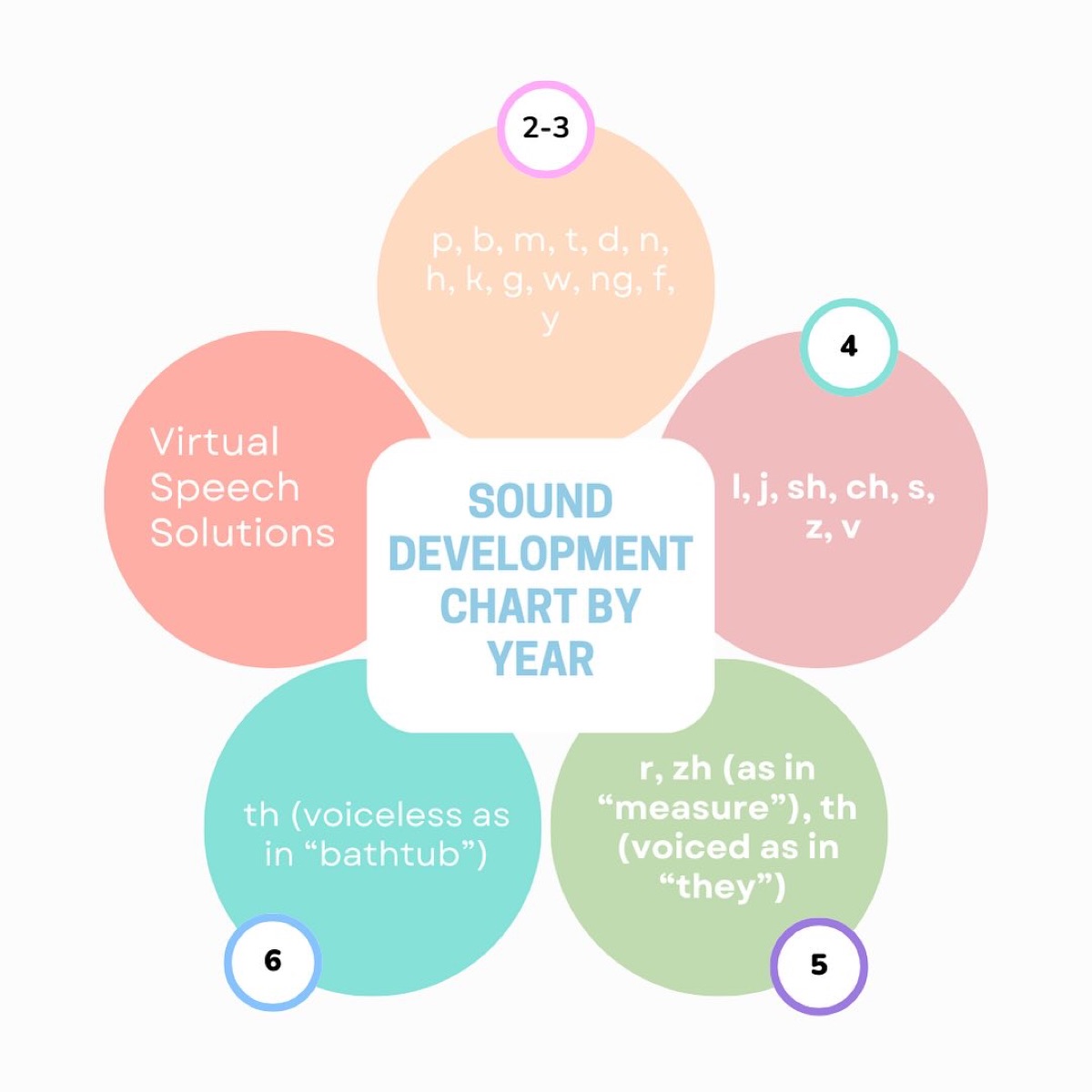
  • Produce most sounds clearly, though r, l, s, th, and blends often remain in progress.

Worth a conversation with an SLP

  • Unfamiliar adults frequently cannot understand them.
  • Cannot answer simple questions about a story or their day.
  • Sentences remain short, or grammar is markedly behind peers.
  • Noticeable stuttering that is worsening, lasting longer than six months, or accompanied by visible tension or avoidance.

By age 5

What most 5-year-olds can do

  • Speak in full, mostly grammatical sentences.
  • Tell a connected story with a beginning, middle, and end.
  • Follow multi-step directions.
  • Be understood by everyone, with r, th, and some blends still developing.
  • Begin rhyming and identifying starting sounds, the foundations of early literacy.

Worth a conversation with an SLP

  • Speech is still difficult for unfamiliar listeners to understand.
  • Struggles to retell events or follow classroom directions.
  • Has difficulty with rhyming or sound awareness, which can signal later reading difficulty.
  • Avoids speaking in group settings because of how they sound.

Signs that warrant attention at any age

A few patterns matter regardless of age:

  • Loss of skills. Any regression in speech, language, or social engagement should be evaluated promptly.
  • No response to sound. Hearing should be checked first. It underlies much of speech development.
  • Feeding or swallowing difficulty. Persistent coughing, choking, or extreme food selectivity.
  • Your own persistent concern. Parents are usually right that something is different, even when they cannot name it.

Why waiting is rarely the better option

“He’ll grow out of it” is sometimes true. The difficulty is that there is no reliable way to know in advance which children will and which will not, and the window where intervention is most efficient is early. An evaluation is not a commitment to therapy. It is information.

Next steps

If something here matched what you are seeing, an evaluation will tell you far more than another few months of watching. For a fuller picture of what to look for, read our guide to signs your child may need speech therapy, or see what to expect from speech therapy in Murrieta and Temecula.

Virtual Speech Solutions provides evaluations and therapy in our Murrieta clinic and via teletherapy across California, serving families in Temecula, Menifee, and throughout Southwest Riverside County. Contact us or call (951) 223-5435 to schedule a consultation.

10 Signs Your Child May Need Speech Therapy

Most parents who call us start the same way: “It’s probably nothing, but…” That instinct is worth listening to. Below are ten signs that a speech-language evaluation is worth scheduling, not ten signs that something is wrong.

1. Very few words by age two

By around two, most children use at least 50 words and have started combining them. A much smaller vocabulary, or no two-word phrases, is the most common reason for an early referral.

2. Strangers cannot understand them

Familiar adults decode a lot through context. A useful test is whether someone outside the household understands your child. By three, unfamiliar listeners should understand roughly three-quarters of what a child says; by four, nearly all of it.

3. They understand far more than they say

A child who follows directions well but barely speaks may have a gap between receptive and expressive language. This is common and treatable. We explain it in “my child understands everything but isn’t talking”.

4. Skills have gone backwards

Any loss of words, gestures, or social engagement that a child previously had should be evaluated promptly, at any age. This is the one sign on this list that is genuinely time-sensitive.

5. Frustration around communication

Meltdowns that cluster around not being understood, rather than around tiredness or transitions, often point to a communication bottleneck rather than a behavioral one.

6. Stuttering that is not settling

Brief periods of disfluency are normal in preschoolers. Worth evaluating: stuttering lasting more than six months, worsening over time, or accompanied by visible tension, blocking, or avoiding words.

7. Difficulty following directions

By three, most children manage two-step directions. Persistent difficulty may reflect a receptive language difficulty, or hearing. Both are worth ruling out.

8. Sound errors past the expected age

Sounds develop on a schedule. Early sounds like p, b, m, and t should be solid by three. Later ones (r, l, s, th) can reasonably still be developing at five or six.

9. Limited social communication

Little eye contact, not responding to their name, limited pointing or showing, or minimal interest in interaction are worth discussing with both your pediatrician and an SLP.

10. Feeding or swallowing difficulty

Persistent coughing or choking during meals, extreme food selectivity, or difficulty moving from purees to textures fall within an SLP’s scope and are frequently overlooked.

What an evaluation actually involves

A comprehensive evaluation combines standardized testing, play-based observation, and a detailed conversation with you. For young children it mostly looks like playing. You leave with a clear picture of which skills are age-appropriate and which are not, and a recommendation, which is sometimes simply “keep an eye on this.”

For concrete age-by-age benchmarks, see our speech and language milestones guide. For what therapy looks like locally, see speech therapy in Murrieta and Temecula.

Talk to someone

If you have been going back and forth on this for a while, that is usually its own answer. Virtual Speech Solutions offers evaluations at our Murrieta clinic and by teletherapy across California, serving Temecula, Menifee, and Southwest Riverside County. Contact us or call (951) 223-5435.

Request an Appointment

Private Practice: for families and individuals.

    “Please do not include medical, diagnostic, or other sensitive health information in this form. Our team will contact you to complete the appropriate intake paperwork securely.”

      “Please do not include medical, diagnostic, or other sensitive health information in this form. Our team will contact you to complete the appropriate intake paperwork securely.”

        “Please do not include medical, diagnostic, or other sensitive health information in this form. Our team will contact you to complete the appropriate intake paperwork securely.”

        Partner With VSS

        Contracting & Staffing: for schools and districts.

          “Please do not include medical, diagnostic, or other sensitive health information in this form. Our team will contact you to complete the appropriate intake paperwork securely.”

            “Please do not include medical, diagnostic, or other sensitive health information in this form. Our team will contact you to complete the appropriate intake paperwork securely.”


              “Please do not include medical, diagnostic, or other sensitive health information in this form. Our team will contact you to complete the appropriate intake paperwork securely.”